Commander is a high-variance format, but many core effects stay useful year after year. In 2026, it is still possible to build a strong deck with commons and uncommons, plus a few low-cost rares. The key is to focus on effects that scale in multiplayer: ramp that fixes colors, removal that hits many targets, card draw that keeps pace, and protection that keeps a key creature or engine in play. This article reviews Commander staples that often cost under $2, with brief notes on why they remain dependable. Prices vary by printing and region, so treat the dollar amount as a typical target rather than a guarantee.
Mana ramp and color fixing
Ramp is the most reliable way to raise deck performance at low cost. In 2026, two-mana rocks and simple land-search spells remain the base layer for many lists. They are easy to cast, they smooth openings, and they help you keep up with faster tables without needing premium artifacts.
Two-mana artifacts
Arcane Signet is often near the $2 line depending on supply, and it remains one of the simplest fixes for any multicolor deck. Fellwar Stone is similar in role and can tap for many colors in most pods. Mind Stone is less about fixing and more about tempo, but it has value later because it can turn into a card. Thought Vessel is often inexpensive and matters in decks that draw extra cards, since it removes the maximum hand size limit.
Green land search
If you play green, spells that put lands onto the battlefield are still among the best budget tools because they are hard to remove. Rampant Growth and Farseek remain standard, and Nature’s Lore can be a bargain when it is reprinted. Sakura-Tribe Elder is also a staple because it blocks early attackers and then cashes in for a land at instant speed. These cards help decks function even with modest mana bases.
Removal that stays relevant
Commander boards grow quickly. Budget decks need removal that is flexible, efficient, and not too narrow. The best low-cost options either hit many kinds of threats or trade at a favorable rate in mana. In 2026, many good answers remain widely printed, which keeps them within reach.
Single-target staples
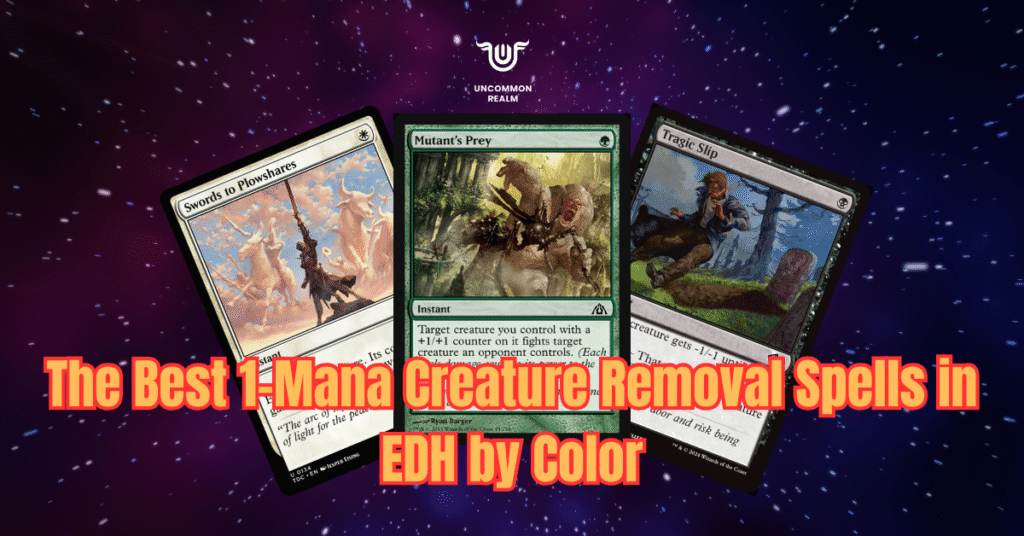
Swords to Plowshares is often the best value white removal spell, since it answers almost any creature for one mana. Path to Exile can also be under $2 and is still efficient, even if the land matters in some matchups. In black, Go for the Throat and Infernal Grasp are clean answers that fit most metas. In red, Chaos Warp remains one of the few ways to remove any permanent type, which matters when enchantments or planeswalkers take over. In green, Return to Nature and Wilt provide artifact and enchantment removal with added utility.
Board wipes on a budget
Full resets can still be inexpensive if you choose the right ones. Blasphemous Act is a classic because it often costs one mana in multiplayer and clears large boards. In white, Day of Judgment-type effects can be found under $2 depending on the exact printing. In black, Crux of Fate and similar creature wipes drop in price after reprints and remain playable in many midrange pods.
Card draw and card advantage
Many Commander games are decided by who keeps drawing live cards. Budget lists can still draw well if they use repeatable engines and efficient bursts. The best options fit many strategies, reward normal game actions, or scale with the table.
Repeatable engines
Skullclamp is sometimes close to $2 and can be one of the most powerful tools in token decks or lists built around small creatures. Phyrexian Arena is not always under $2, but it often approaches that range in lower-cost printings and remains a steady source of cards in slower games. In blue, Bident of Thassa can be inexpensive and turns attacks into draws, which encourages proactive play. In green, Beast Whisperer can be a budget engine in creature-heavy builds, though price can vary by set and demand.
Efficient burst draw
Ponder and Preordain can be cheap ways to improve early turns, especially in combo or control shells. Night’s Whisper and Sign in Blood are still among the best two-mana draw spells in black. In red, Faithless Looting remains a strong filter, especially for graveyard plans. In green, Harmonize is simple and effective when your deck needs raw cards without extra setup.
Protection and interaction
Low-cost decks often lose momentum when a key creature is removed. Protection spells, counterspells, and recursion reduce that risk. The goal is not to stop everything, but to stop the one spell that would break your plan.
Protection tools
Swiftfoot Boots is frequently near the $2 mark and is a common inclusion because it grants both haste and hexproof. If it is above budget,Whispersilk Cloak can be a lower-cost option and also helps a commander connect in combat. In white, Gods Willing and Blacksmith’s Skill can protect a key piece for one mana, with the added benefit of flexibility. In green, Tamiyo’s Safekeeping is another cheap way to protect both creatures and other permanents.
Budget counterspells and recursion
Counterspell remains inexpensive and reliable in blue decks. Negate and Arcane Denial are also common budget answers, and they help you interact without holding up too much mana. For recursion, Eternal Witness can be near $2 and fits many green decks. In black, Reanimate is usually above $2, but cheaper options like Animate Dead can sometimes fall into range, and Victimize remains a strong budget reanimation spell in creature-based lists.
Utility lands and closing notes
Mana bases do not need to be expensive to be functional. Budget dual lands and a few utility lands improve consistency without taking many slots. They also help you spend your mana each turn, which is essential in multiplayer.
Command Tower is often inexpensive and is still the default land in multicolor Commander. Path of Ancestry is strong in tribal lists and still good elsewhere as a tapped fixer with upside. Exotic Orchard can be a budget all-star in many pods. For utility, Bojuka Bog remains one of the best low-cost graveyard checks, and Rogue’s Passage helps end stalled games by forcing damage through blockers.
When you select staples under $2, focus on roles, not brand names. Choose ramp that fixes, removal that is broad, draw that is repeatable, and protection that is cheap to hold up. With those pieces in place, most commanders can support a coherent plan, even on a tight budget. The result is a deck that plays smoothly, interacts responsibly, and stays competitive across common 2026 tables.