Commander, as a multiplayer format, depends on tacit social agreements about pacing, interaction, and the reasonable conversion of advantage into victory. “Salt-inducing” cards are those that disproportionately undermine these expectations, either by constraining agency, invalidating prior decisions, or prolonging games after a decisive advantage is established. The following selections are not inherently unethical to play; rather, they are recurrent flashpoints in table politics because they reshape the experience more than they merely improve win percentage.
Conceptual Criteria for “Salt”
Salt often emerges from three overlapping properties: asymmetry (one player benefits while others are constrained), inevitability (the table’s remaining choices no longer meaningfully affect outcomes), and temporal drag (the game takes substantially longer without increased engagement). Cards that repeatedly reset progress, deny resources, or erase interaction norms tend to score highly on these dimensions, particularly when combined with recursion, tutors, or commanders that enable consistent deployment.
Top 10 Salt-Inducing Cards in Commander
1) Cyclonic Rift
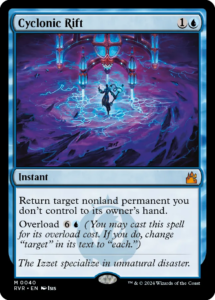
As an overloaded, instant-speed asymmetrical reset, Cyclonic Rift compresses multiple turns of development into a single opponent’s end step. It often converts modest advantage into near-inevitability by stripping boards while preserving the caster’s. The displeasure it provokes is less about interaction and more about the abrupt invalidation of collective progress with minimal opportunity cost.
2) Armageddon
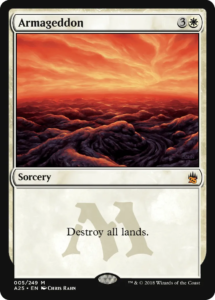
Mass land destruction is a canonical source of negative affect because it attacks the baseline resource system. Armageddon can be strategically defensible when it immediately secures a win, but it is frequently perceived as socially costly when it produces extended, low-agency turns. The card’s reputational burden arises from its capacity to convert a multiplayer game into a slow, uneven recovery exercise.
3) Stasis
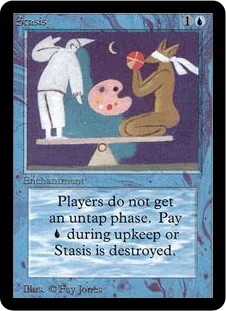
Stasis exemplifies temporal drag: it arrests the normal cadence of untap-based play and demands specialized construction to break parity. Even when “solved” by the controller, the rest of the table often experiences a prolonged inability to deploy answers. The resulting asymmetry is experiential as well as strategic, since most gameplay becomes procedural rather than decision-rich.
4) Winter Orb
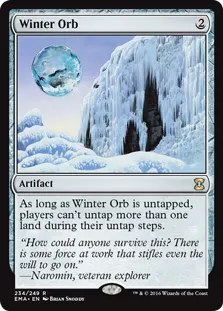
Like Stasis, Winter Orb constrains the primary resource of tempo, but it does so in a way that is easier to deploy incidentally and easier to protect with artifact synergies. It is particularly salt-inducing when the controller can untap their own permanents via effects that bypass the restriction, producing a lopsided game state that feels predetermined.
5) Static Orb
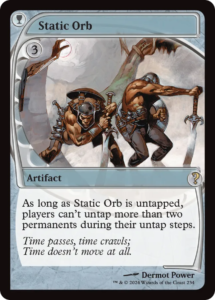
Static Orb intensifies the same phenomenon by limiting untaps across the permanent spectrum, not merely lands. The practical effect is a broad suppression of agency, as the ability to attack, block, cast, and respond becomes tightly rationed. When paired with tap outlets to “turn it off” on the controller’s turn, it creates a conspicuous disparity that invites frustration.
6) Rhystic Study
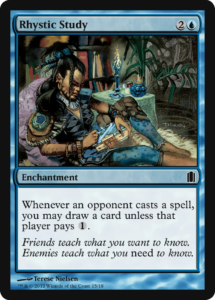
Rhystic Study induces salt through social friction rather than hard restriction. It repeatedly forces opponents to choose between suboptimal sequencing (paying the tax) and conceding incremental advantage (allowing draws), while also imposing a conversational burden on the table. The sense of irritation often stems from the card’s persistent demand for attention and the cumulative snowballing it enables.
7) Smothering Tithe
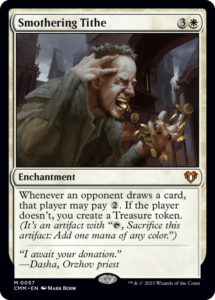
Smothering Tithe functions as a scaling resource engine that punishes the normal act of drawing cards. In practice, it frequently produces a sudden, explosive mana advantage that compresses the game into a single player’s turn cycle. Salt arises when opponents feel compelled to spend early turns paying taxes, only to fall behind anyway, or when the controller converts the treasure differential into immediate dominance.
8) Expropriate
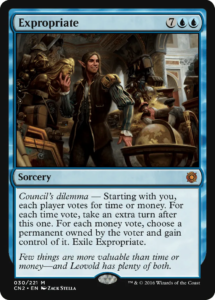
Expropriate is a paradigmatic “inevitability” spell: it transforms a single cast into multiple extra turns and permanent acquisitions, with political voting that often reads as illusory choice. Because it tends to end games via extended solitaire sequences, opponents frequently experience it as a procedural formality rather than a contest. The negative response is amplified by how readily it is copied or recurred in blue-based shells.
9) Teferi’s Protection
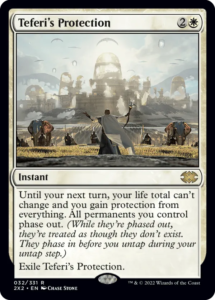
Teferi’s Protection is not oppressive in the same structural way as stax or land destruction, yet it can be salt-inducing because it nullifies pivotal interaction at minimal risk. It often functions as a one-card rebuttal to a table’s coordinated effort to answer a threatening board, and it can render combat math and board wipes moot. The emotional reaction is strongest when it reverses a “deserved” punishment for overextension.
10) Contamination
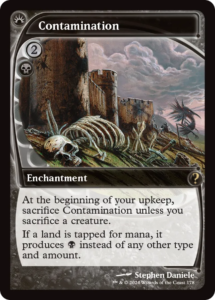
Contamination is a severe color-based lock that restricts mana production while leveraging sacrifice synergies to maintain itself. In many pods, it effectively removes multicolor decks from meaningful participation until it is answered, which may not be feasible under the lock itself. The card’s salt profile comes from how directly it translates a single resolved enchantment into widespread functional inaction.
Practical Implications for Deckbuilding and Play
These cards share a common lesson: the strongest predictors of negative table response are not raw power, but perceived denial of participation and disproportionate time costs. Players who include such effects can mitigate conflict through clear pregame communication, by sequencing them as win-closers rather than open-ended constraints, and by ensuring their decks can convert advantage promptly. Conversely, pods that dislike these dynamics can align expectations via informal bans or by emphasizing efficient interaction to prevent singular cards from defining the experience.