In Magic: The Gathering, resource management dictates success. Players must consistently balance mana acceleration with card advantage. Mana acceleration provides the speed to cast spells early. Card advantage provides the raw pieces needed to sustain a game plan. Most cards in Magic make you choose between these two pillars. A mana rock generates mana but becomes a dead draw late in the game. A draw spell provides resources but does not help you cast them ahead of schedule.
Midnight Clock splits this division. First printed in Throne of Eldraine, this blue artifact acts as a bridge between early-game utility and late-game resource renewal. It is a unique piece of design. It asks players to invest early for a delayed, explosive payout. This analysis will examine the mechanical structure, economic efficiency, and strategic applications of Midnight Clock, with a specific focus on multiplayer Commander.
The Anatomy of the Clock
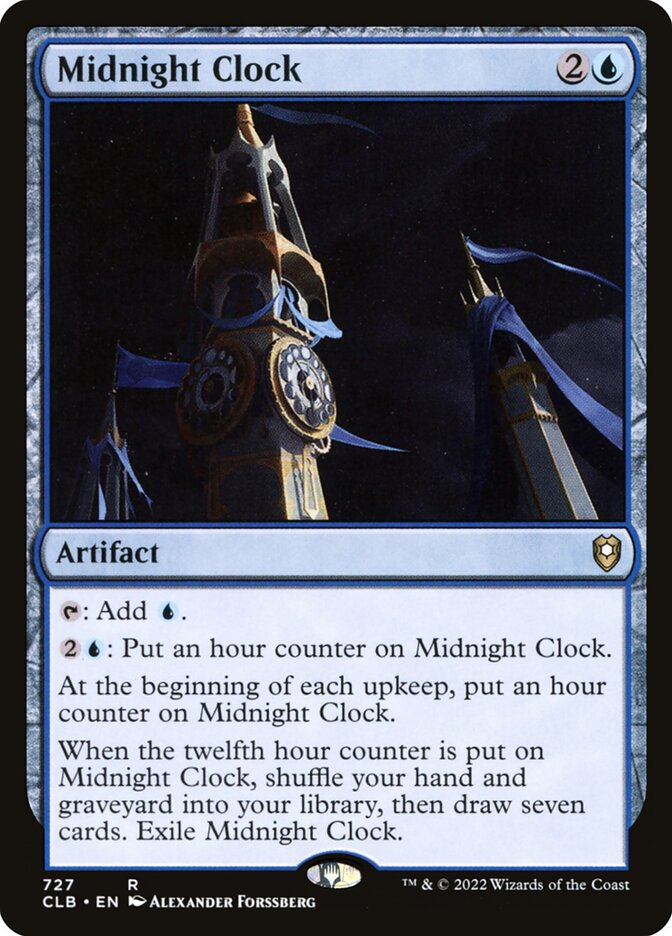
To understand Midnight Clock, we must first break down its component parts. It costs 2U (two generic mana and one blue mana) to cast. This places it in the crowded category of three-mana acceleration options.
If you buy from these links we will receive a small commission
Its text reads as follows:
{T}: Add {U}.
{2}{U}: Put an hour counter on Midnight Clock.
At the beginning of each upkeep, put an hour counter on Midnight Clock.
When the twelfth hour counter is put on Midnight Clock, shuffle your hand and graveyard into your library, then draw seven cards. Exile Midnight Clock.
The card functions via three distinct operational layers: immediate utility, passive progression, and active investment.
1. Immediate Utility: The Baseline Mana Rock
At its base level, Midnight Clock is a mana rock that taps for blue. In modern Magic, three-mana rocks face heavy competition. Two-mana options like Arcane Signet, Mind Stone, and Fellwar Stone are the standard choice for speed. They allow players to jump from two mana to four mana on turn three.
A three-mana rock must offer significant utility to earn a deck slot. Midnight Clock compensates for its higher cost by shifting its value to the late game. It ensures that your early-game investment is never truly wasted when the board stalls out.
2. Passive Progression: The Upkeep Engine
The defining feature of Midnight Clock is how it tracks time. It receives an hour counter at the beginning of each upkeep. In a standard four-player Commander game, a full turn cycle contains four upkeeps. This means the clock ticks four times before your next main phase begins.
If undisturbed, Midnight Clock will hit its twelve-counter threshold in exactly three full round cycles. This passive ticking cost zero mana. It turns the multiplayer nature of Commander into a direct mechanical advantage. In a two-player format, the clock takes six full turns to go off. In a four-player pod, that timeline is cut directly in half.
3. Active Investment: The Mana Sink
The artifact includes a activated ability: for 2U, you can manually add an hour counter. This serves as an excellent mana sink. If you leave mana open for counterspells or interaction, but your opponents do not cast anything worth countering, you can dump that unused mana into the clock right before your turn. This flexibility prevents wasted turns and accelerates your path to a fresh hand.
The Economic Efficiency of Refilling Your Hand
The ultimate reward for waiting out the twelve hours is a Timetwister style effect. You shuffle your current hand and your graveyard into your library, then draw a fresh hand of seven cards.
Let us analyze the raw mana economy of this trigger.
| Effect Element | Standalone Card Equivalent | Average Mana Value |
|---|---|---|
| Mana Generation | Eye of Ramos / Sky Diamond | 2 to 3 Mana |
| Graveyard Protection / Recursion | Feldon’s Cane / Clear the Mind | 1 to 3 Mana |
| Draw Seven Cards | Timetwister / Time Reversal | 3 to 5 Mana |
| Total Combined Value | — | 6 to 11 Mana |
You get all of this utility for an initial investment of just three mana. Furthermore, standard “wheel” effects affect all players at the table. Cards like Windfall or Wheel of Fortune can accidentally give your opponents the answers they need. Midnight Clock is completely asymmetrical. Only you get the new hand. Your opponents keep their current cards, giving you a massive resource advantage.
Strategic Considerations and Risks
While the upside of Midnight Clock is immense, playing it requires careful tactical planning. The most critical variable is telegraphing.
Because the counters are visible to the entire table, your opponents know exactly when you are about to draw seven cards. This creates a psychological target. If an opponent has removal like Nature’s Claim or Demolish, they will wait until the clock has ten or eleven counters to destroy it. This completely wipes away your multi-turn investment.
To mitigate this risk, you can use the active ability to surprise the table. If you hold up six or nine mana, you can activate the clock multiple times in a single end step. This allows you to force the twelve-counter trigger before your opponents have a chance to untap and find an answer.
Another factor to consider is the exile clause. Once the clock strikes twelve, it exiles itself. This prevents easy recursion loops. You cannot simply use an Archaeomancer or a Regrowth to bring it back and start the cycle over. It is a one-time injection of massive value, designed to push you into a winning position.
Optimal Deck Archtypes
Midnight Clock performs exceptionally well in specific structural archetypes:
- Spellslinger and Control Decks: These strategies love to play at instant speed. They hold up mana for interaction and need ways to use that mana if no threats appear. The clock provides the perfect outlet for that open mana while ensuring they never run out of gas.
- Proliferate and Counter Themes: Decks commanded by Atraxa, Praetors’ Voice or Vorel of the Hull Clade can add counters to the clock at an accelerated rate. This turns a three-turn wait into a single-turn surprise.
- Wheel and Draw-Matters Strategies: Decks built around Nekusar, the Mindrazer or The Locust God trigger powerful passive abilities whenever cards are drawn. Forcing a seven-card draw on your upkeep can trigger an avalanche of damage or tokens before you even draw your normal card for the turn.
Conclusion
Midnight Clock is a masterclass in modern card design for multiplayer formats. It takes a boring staple—the three-mana rock—and transforms it into a tense, rewarding minigame. By tying its progression to every player’s upkeep, it scales beautifully within Commander. It asks you to navigate the risk of public information in exchange for an unparalleled resource reload. For any blue deck looking to secure its late-game survival, the Midnight Clock is a beautiful inclusion.
If you buy from these links we will receive a small commission