Players look for cards that offer great value for a low cost. Some spells grant a single massive bonus. Others spread their power across the board. Spreading power is often safer and more flexible.
A prime example of this design philosophy is Travel Preparations. First printed in the Innistrad expansion in 2011, this green and white sorcery looks simple at first glance. Yet, it became a famous cornerstone of aggressive strategies. It demonstrates how splitting costs can change the pace of a game. This article will analyze the mechanical structure, historical success, and ongoing utility of Travel Preparations in both Limited and Cube formats.
If you buy from these links we will receive a small commission
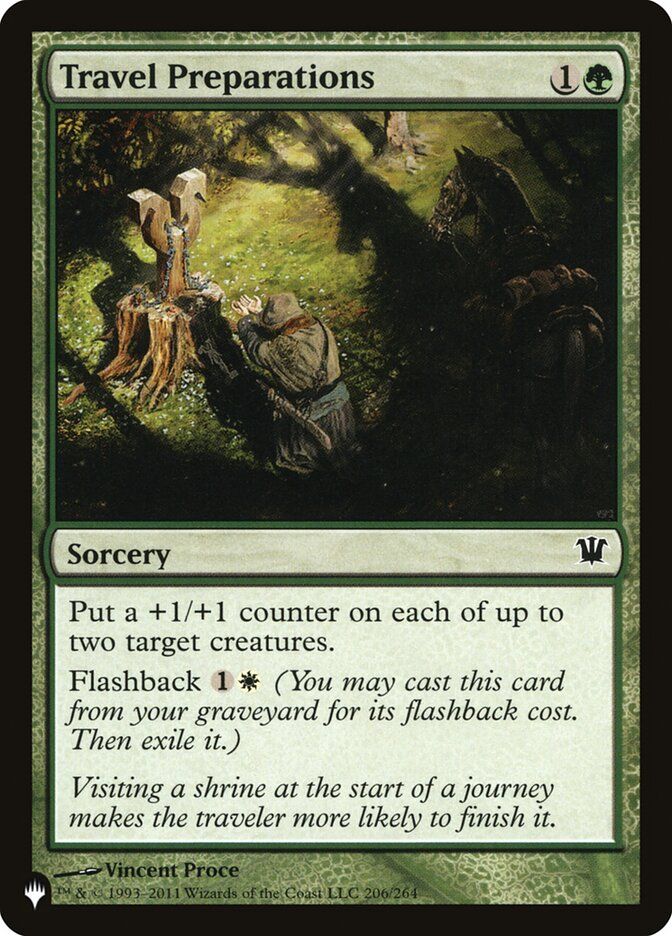
Travel Preparations — {1}{G}
Sorcery
Put a +1/+1 counter on each of up to two target creatures.
Flashback — {1}{W}
The Mechanical Structure and Resource Split
To assess the value of Travel Preparations, we must examine its raw numbers. The front side of the card costs one generic mana and one green mana. For this investment, you can place a permanent +1/+1 counter on two different creatures.
This immediate effect adds two power and two toughness to your board state. Paying two mana for two permanent stats is a fair rate in Magic. However, the card becomes elite because of its second line of text: Flashback.
The Flashback cost requires one generic mana and one white mana. When you cast it from your graveyard, you get the exact same effect a second time.
Let us break down the total economic investment of this card:
- Initial Cast: Two mana for two +1/+1 counters.
- Flashback Cast: Two mana for two +1/+1 counters.
- Total Investment: Four mana for four permanent +1/+1 counters.
This split cost offers immense strategic flexibility. A player does not need four mana up front to get full value. Instead, they can play two creatures on turns one and two. On turn three, they can cast Travel Preparations to tilt combat in their favor. On turn four, they can use the Flashback option while still holding up mana for other spells. This allows an aggressive deck to maintain pressure without stalling its development.
Limited Format Dominance: The Innistrad Archetype
The true power of Travel Preparations was first discovered in Innistrad Limited environments. Draft formats rely heavily on combat math. Small shifts in power and toughness decide which creatures can block and survive.
In Innistrad draft, the Green-White (Selesnya) and Naya human archetypes were highly dominant. Travel Preparations was a common card in that set. This meant players could easily draft multiple copies. The card single-handedly altered how opponents had to approach combat.
Consider a standard opening sequence. A player casts a 1/1 creature on turn one and a 2/2 creature on turn two. Normally, an opponent with a 3/3 blocker can stop these attacks completely. If the attacking player casts Travel Preparations, their creatures become a 2/2 and a 3/3. The opponent can no longer block safely.
If the opponent refuses to block, they take five damage instead of three. On the next turn, the Flashback ability can push those creatures to a 3/3 and a 4/4. This rapid scaling quickly outpaces traditional removal and blockers. The card was so dominant that Wizards of the Coast later upshifted its rarity to uncommon in future reprint sets to protect the balance of Limited formats.
Applications in Cube and Pauper Formats
Beyond its original Limited environment, Travel Preparations remains a popular choice in alternative formats. It is a staple in many Pauper Cubes and specialized draft environments.
| Format Type | Role of the Card | Primary Synergy |
| Pauper Cube | Aggro Finisher / Midrange Value | Token generation and go-wide strategies |
| Selesnya Counters | Mechanical Enabler | Spells that trigger when counters are placed |
| Heroic Archetypes | Target Trigger | Cards that grant bonuses when targeted by a spell |
In a Pauper Cube, developers limit the card pool to common cards only. In this environment, efficient removal is sparse, and board stalls are frequent. Travel Preparations breaks these stalls. It rewards players who draft a high density of low-cost creatures.
The card also pairs perfectly with token strategies. Decks that use cards like Raise the Alarm or Sprout Swarm create multiple small bodies. Spreading counters across these tokens turns a swarm of weak 1/1 creatures into a lethal army of 2/2 threats.
Furthermore, because it is a single card that can be cast twice, it provides inherent card advantage. Aggressive decks often run out of resources quickly. Travel Preparations solves this issue by acting as two separate spells stored in a single deck slot.
Strategic Nuances and Rules Interactions
While the card is simple to use, players must navigate a few technical rules to maximize its safety. The most important rule involves targeting requirements.
The text states you can put a counter on “each of up to two target creatures.” This wording is highly beneficial. If you cast the spell targeting two creatures, and an opponent uses a removal spell to destroy one of them in response, the spell does not fizzle. The remaining creature will still receive its +1/+1 counter.
However, you cannot target the exact same creature twice with a single casting to give it two counters. If you only control one creature, you can choose to target just that single body. This reduces the total stat output of the spell from two counters to one, which lowers its mathematical efficiency. Therefore, the ideal time to cast Travel Preparations is always when you have at least two active threats on the battlefield.
Another key aspect is the speed of the spell. As a sorcery, you can only cast it during your main phase when the stack is empty. You cannot use it as a trick during your opponent’s turn to save a blocker. This limitation forces players to be proactive. You must commit your mana and signal your path forward before combat begins.
Conclusion
Travel Preparations is a masterclass in elegant card design. It does not feature complex mechanics or long walls of text. Instead, it uses a smart mana structure and simple math to deliver excellent performance. By splitting its cost across two turns and two colors, it gives aggressive decks the exact tool they need to stay ahead of the curve. Whether you are exploring historical drafts or building a custom Cube, this green and white sorcery remains a fantastic example of low-cost efficiency.
If you buy from these links we will receive a small commission